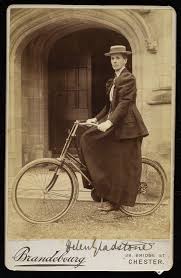
 Helen Gladstone (August 28, 1849 - August 19, 1925) was a pioneering British educator and social worker, best known as a key figure in the early development of women's
higher education at Cambridge University.
Helen Gladstone (August 28, 1849 - August 19, 1925) was a pioneering British educator and social worker, best known as a key figure in the early development of women's
higher education at Cambridge University.Queer Places:
Hawarden Castle, Dig Ln, Deeside CH5 3QU, UK
University of Cambridge, 4 Mill Ln, Cambridge CB2 1RZ
St. Deiniol Churchyard, Church Ln, Hawarden, Deeside CH5 3LT, United Kingdom
Helen Gladstone (August 28, 1849 - August 19, 1925) was a pioneering British educator and social worker, best known as a key figure in the early development of women's
higher education at Cambridge University.
Born on August 28, 1849, Helen Gladstone was the youngest daughter of Catherine Glynne and William Ewart Gladstone, who served four terms as the Liberal Prime Minister of the United Kingdom. Her sister was Mary Gladstone Drew. She grew up in an influential political and intellectual household, closely involved with village schools and parish life in Hawarden, Wales.
Encouraged by her sister Mary, Helen broke away from standard domestic expectations in 1877 to study political economy and English at Newnham College, Cambridge.
She quickly became an integral part of the institution. She served as secretary to Newnham's first Principal, Anne Clough, and was later appointed Vice-Principal of Sidgwick Hall (then North Hall) in 1882.
In 1886, she was offered the opportunity to become the first Principal of Royal Holloway College. She turned it down, suspecting the board simply wanted her for the "Gladstone" name, and chose to remain at Newnham.
In 1896, she resigned her role at Cambridge to care for her aging parents until their deaths.
After leaving Cambridge, Helen dedicated herself to community work and social reform:
Along with housing reformer Octavia Hill, she helped establish the Women's University Settlement in Southwark, London (now the Blackfriars Settlement).
From 1901 to 1910, she served as the Warden of the settlement, leading educational and welfare initiatives for women and children in impoverished urban areas.
In 1910, she retired to Hawarden, where she lived at Sundial until her death on August 19, 1925.
While Helen Gladstone never explicitly defined herself using modern LGBTQ+ terminology—which did not exist in its present form during the late 19th and early 20th centuries—her life falls into a recognized pattern within queer historical studies:
Unlike many women of her social standing, Helen never married or pursued heterosexual courtship, opting instead to build a career around women's institutions and communal living environments.
Her life was centered almost entirely within homosocial spaces, including the female-led academic community at Newnham College and women-led social reform settlements.
Historians of sexuality frequently study women of Helen's era who lived within close-knit, passionate female networks. While specific romantic partnerships in her private correspondence are rarely highlighted in mainstream biographical summaries, her life reflects the late-Victorian phenomenon of educated women forming deep, lifelong emotional bonds with female colleagues instead of traditional domestic marriage.
References:
Support this project
This website is a passion project researched, developed, and funded entirely by me. If you find the content valuable and would like to help support the ongoing research and hosting costs, any contribution is deeply appreciated.
Thank you for keeping this independent resource alive!
My books on Amazon: Elisa Rolle's books